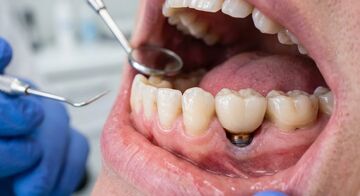
Leaving a gap in your smile can have a significant impact on your confidence. This is why your dentist will often recommend a replacement solution after tooth loss.
Leaving a gap can impact the health of your remaining teeth and might lead to premature wear and tear of the teeth on the opposite side. There is also the risk that the surrounding and opposite teeth could become looser due to a lack of support.
The surrounding teeth may shift into the space and become crooked, while the opposite tooth will have nothing to press against when you bite. Patients with missing teeth may avoid certain foods, which could contribute to malnutrition over time. And there is also a risk of social isolation if the patient becomes self-conscious about their appearance.
Thankfully, there are options available following tooth loss that will help to restore the smile and the bite. The two most common methods for restoring a smile after tooth loss would be a dental bridge or a dental implant.
If you’re not sure which approach is right for you, we’ve put together this short guide to help you get to grips with the options.
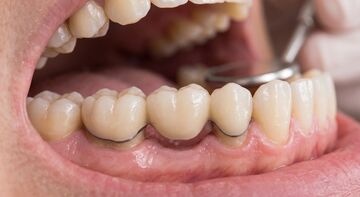
What is a dental bridge?
A dental bridge is a dental restoration that uses two crowns placed on either side of a prosthetic tooth. The tooth fits in the gap, and the crowns are attached to the surrounding teeth. This provides a remarkably natural-looking restoration that can last for years and years with good care.
Benefits of a dental bridge
- Provides support to the surrounding teeth to help build strength.
- Variety of material options available, including ceramic and porcelain fused to metal.
- Restoration can be completed in just a few visits over a few weeks.
- The force of the bite is distributed over the surrounding teeth, keeping the jaw bone engaged.
- A single bridge can support 1 – 4 teeth, known as pontics.
- Bridges can also be attached to the back of the teeth with metal wings if the surrounding teeth don’t need crowns.
Downsides of a dental bridge
- This procedure requires preparation of the surrounding teeth, including removal of the enamel, so it could weaken those teeth over time.
- A dental bridge has a limited lifespan of around 5 – 15 years, so it will need to be replaced eventually.
- Patients will need to pay close attention to cleaning around and under their bridge to prevent bacteria buildup.
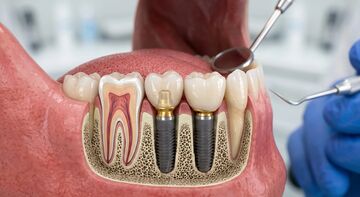
What is a dental implant?
A dental implant is a small metal post that is placed in the jawbone to provide an artificial root for a replacement tooth. The titanium screw bonds with the jawbone to create a strong anchor for a crown.
This procedure takes place over the space of 3 – 6 months, with multiple stages and periods of healing between appointments.
Benefits of a dental implant
- Provides a restoration that looks, feels and functions like a natural tooth.
- Helps to stimulate the jawbone which can help to prevent shrinking that can change the shape of the face.
- Neighbouring teeth are left unaltered and are supported by the restoration.
- Patients can enjoy a wide range of foods without worrying about losing their restoration.
- Caring for the implant is simple and patients can brush and floss as they normally would.
Downsides of a dental implant
- The treatment is long and extensive, often taking months from start to finish. Some patients prefer a quicker solution.
- There is a small risk of implant rejection if the patient develops gum disease or if they continue habits like smoking.
- Dental implants are more expensive than other treatments, likely because of the long-term value of this treatment.
Which treatment is right for you?
To determine which treatment is right for you, you will first need to speak to your dentist. They can help you to understand which treatments are available to help close the gap in your smile.
If both are an option and you can’t decide which one you prefer, consider the following questions:
What is your budget for treatment?
While a dental bridge will cost hundreds, a dental implant could cost thousands, so this might be the main deciding factor for many patients. When thinking about the cost, remember that a dental implant can last for a lifetime, while a bridge may need to be replaced in as little as 5 years.
What is your timeline for a restoration?
While a dental bridge can be fitted and placed in a matter of weeks, a dental implant is going to take months to complete. If you’re hoping to achieve a smile restoration for a specific deadline, you might want to consider a faster restoration like a dental bridge.
How healthy are the surrounding teeth?
If you have lost a tooth due to dental decay, there is a risk that the surrounding teeth may also be weakened. In this case, they might benefit from a crown restoration. If the surrounding teeth are very healthy, a dental implant might be better suited to help avoid preparation of these teeth.
Contact us to make an appointment
Exclusive Offer
Airflow stain removal from our hygienist



Can Anyone Have Dental Implants?
07.09.2026


Do Dental Implants Feel Like Real Teeth?
09.07.2026
Time for you perfect smile?
Book your consultation today
When visiting our practice you know you are visiting the dental professionals trained to the highest standards. You are greeted by our welcoming staff, who share the same aim, to make your visit with us as comfortable and stress free as possible.